


One-Connector-for-All
In the fast-paced transition to sustainable transportation, electric vehicles (EVs) have emerged as a cornerstone of reducing carbon emissions—but their widespread adoption hinges on one critical factor: reliable, fast, and universal charging infrastructure. Among the various charging standards vying for global dominance, the Combined Charging System Type 2 (CCS2) stands out as a unifying solution, bridging the gap between slow AC charging for daily use and rapid DC charging for long-distance travel. As cities, automakers, and energy providers rally around interoperable charging, CCS2 has become more than just a technical standard—it’s a catalyst for making EVs accessible to millions.
What Makes CCS2 Unique? A “One-Connector-for-All” Design
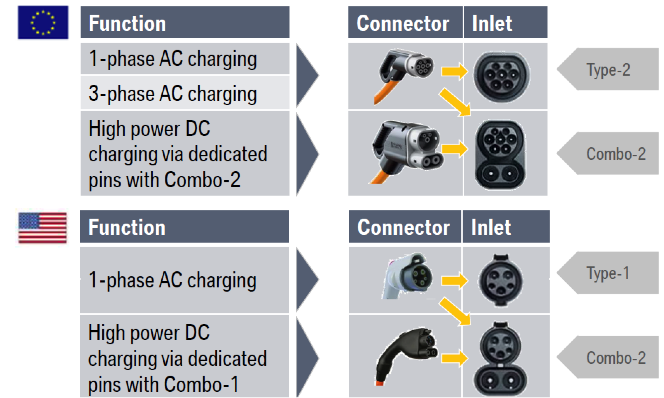
At its core, CCS2 solves a fundamental pain point for EV owners: the hassle of switching between different chargers for different needs. Unlike older standards that require separate connectors for AC and DC charging, CCS2 integrates both functionalities into a single port, blending the familiar Type 2 AC connector (used for home or workplace charging) with two additional high-power DC pins.
The physical design is intuitive: the upper section of the CCS2 connector retains the 7-pin layout of the Type 2 standard, which handles AC power (typically 7kW to 22kW) for overnight or extended charging sessions. The lower section adds two large, robust pins dedicated to DC fast charging, capable of delivering up to 350kW (and beyond) of power. This dual-purpose design means an EV owner can plug into a home wallbox for slow charging or a highway fast-charger for a 10–80% top-up in as little as 15–30 minutes—all with the same connector.
For automakers, this simplicity translates to cost savings and streamlined production: instead of equipping vehicles with multiple charging ports, they can install a single CCS2 port, reducing complexity and weight. For charging network operators, CCS2’s versatility means fewer charger models to deploy, lowering maintenance and inventory costs.
How CCS2 Works: Behind the Scenes of Safe, Smart Charging
CCS2’s functionality isn’t just about hardware—it relies on a sophisticated dance of communication and safety protocols to ensure seamless, risk-free charging. Here’s a breakdown of its key operating mechanisms:
1. The “Handshake”: Vehicle and Charger Communication
Before any power flows, the EV and charger engage in a digital “handshake” to verify compatibility and set safe charging parameters. This happens via two critical signals:
- Control Pilot (CP) Signal: The CP pin acts as the “communication backbone.” For AC charging, it uses pulse-width modulation (PWM) to send the EV information about the charger’s maximum available current (e.g., 16A, 32A). For DC charging, it shifts to Power Line Communication (PLC)—a technology that sends high-frequency data (up to 10 Mbit/s) over the same wire, enabling the EV and charger to exchange detailed data: battery voltage, state of charge (SoC), temperature, and current limits.
- Proximity Pilot (PP) Signal: A preset resistor in the PP pin lets the EV detect that the charger is securely connected and identify the cable’s maximum current capacity (e.g., 50A, 150A). This prevents overloading the cable and ensures safe operation.
2. AC Charging: Slow and Steady for Daily Use
When using AC power (e.g., at home), the CCS2 connector draws electricity from the grid via the Type 2 pins. The EV’s on-board charger (OBC)—a built-in component—converts the AC power to DC, which the battery can store. The charger and EV continuously communicate via the CP signal to adjust the current: if the battery nears full capacity or the OBC detects overheating, the current is reduced to prevent damage.
3. DC Fast Charging: Rapid Power for Long Trips
For DC fast charging (e.g., at highway rest stops), the process skips the OBC entirely. The charger itself converts AC grid power to DC, then sends it directly to the EV’s battery via the two dedicated DC pins. Thanks to PLC communication, the charger dynamically adjusts voltage and current based on the battery’s needs: it starts with a high current to quickly top up the battery, then tapers off as the battery nears full capacity (a process called “constant current/constant voltage” charging). This not only speeds up charging but also protects the battery from degradation.
4. Safety First: Built-in Protections
CCS2 is engineered with multiple layers of safety to prevent electrical hazards:
- Overcurrent/Overvoltage Protection: The charger and EV monitor current and voltage in real time; if either exceeds safe limits, power is cut off instantly.
- Ground Fault Protection: A dedicated protective earth (PE) pin ensures any electrical leakage is routed to the ground, preventing shocks.
- Temperature Monitoring: Sensors in the connector and battery detect overheating; if temperatures rise too high, charging pauses until conditions stabilize.
CCS2’s Global Footprint: From Europe to Asia and Beyond
What truly sets CCS2 apart is its global adoption. Initially developed by European automakers (e.g., Volkswagen, BMW, Daimler), it has quickly become the de facto standard in Europe, where 90% of new EVs and public chargers use CCS2. But its influence doesn’t stop there:
- Asia: China, the world’s largest EV market, adopted CCS2 as a supplementary standard in 2021, alongside its domestic GB/T standard. India, Singapore, and South Korea have also embraced CCS2, aligning their charging networks with global norms.
- Oceania: Australia and New Zealand have mandated CCS2 for all new public fast-chargers, ensuring compatibility with imported EVs from Europe and Asia.
- North America: While the U.S. and Canada historically used CCS1 (a variant of CCS2 tailored to North American grids), major automakers like Ford, GM, and Tesla have announced plans to adopt CCS2 (via the North American Charging Standard, NACS, which is interoperable with CCS2) by 2025. This shift will create a transatlantic charging network, simplifying cross-border travel for EV owners.
This global alignment is a game-changer. For EV manufacturers, it means building a single vehicle model that can be sold in multiple markets without modifying the charging port. For travelers, it eliminates the anxiety of “will my charger work here?”—a key barrier to EV adoption.
The Future of CCS2: Faster, Smarter, More Connected
As EV battery technology advances (with higher voltages and capacities), CCS2 is evolving to keep up. The latest iteration of the standard supports 1,000V DC charging and currents of up to 600A, enabling charging speeds of 600kW or more—fast enough to add 100 km of range in just 2–3 minutes. This will make EVs even more competitive with gasoline cars, as refueling times shrink to near-comparable levels.
Beyond speed, CCS2 is integrating with smart grid technology. Future chargers will use PLC communication to balance energy demand: during peak hours, they can reduce charging speed to avoid straining the grid; during off-peak hours, they can boost speed to take advantage of cheaper, cleaner energy (e.g., from solar or wind). Some chargers already support “vehicle-to-grid (V2G)” functionality, allowing EVs to feed power back into the grid—turning cars into mobile energy storage units.
For consumers, this means CCS2 won’t just be a way to charge their cars—it will be a way to save money on electricity, reduce their carbon footprint, and contribute to a more resilient energy system.
Conclusion: CCS2 as the Backbone of Electric Mobility
In the journey toward a zero-emission future, charging infrastructure is the backbone—and CCS2 is the glue that holds it all together. Its dual AC/DC design, robust safety features, and global adoption have made it the standard of choice for automakers, governments, and energy providers alike. As charging speeds increase, smart grid integration deepens, and cross-border compatibility expands, CCS2 will continue to play a pivotal role in making EVs the norm, not the exception.
For anyone considering buying an EV, or for cities planning charging networks, CCS2 is more than a technical detail—it’s a promise of convenience, reliability, and a sustainable future. As the world charges forward, CCS2 is leading the way.